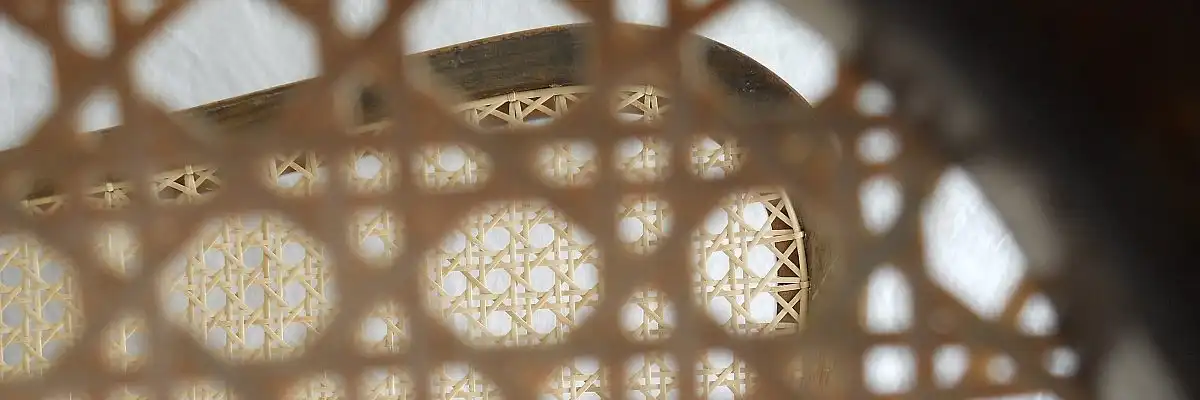
(Ralf) The last of his kind or a dying craft or even the last of his kind – these or similar titles are used to describe reports on the extinction of the basket-making trade (and other professions). And this has been the case for years, if not decades.
Sometimes it sounds or reads as if from tomorrow there will be no more basket makers in the world or even in Germany. Of course, trained basket makers or, as they are called today, wickerwork designers, are harder to find. But they are still being trained. And the original craft is still being taught, such as basket weaving, fine weaving or chair weaving. Just not to the extent that it used to be. In the three years of the apprenticeship, the focus of the training has changed somewhat. What used to be common practice is no longer in demand today. Like so many other things.
But at markets you notice that even younger people are keen to buy something hand-made, such as a basket. The fact that you mostly only see older basket makers there is probably also because the younger generation is more focused on online business. The new generation of wickerwork designers are seen less at markets because they are present in an online world. But they are not dying out.
And now you can see that I’m part of the older generation. Personally, I find it hard to believe in the good craftsmanship and the good quality that goes with it when I look at some of the basketry in online shops and sales platforms. And when it comes to the prices of the goods on offer, I always have the feeling that everything is either far too cheap or even too overpriced. And very often for junk that was mass-produced by cheap hands somewhere in the world.
And the “I don’t like it after all, I’ll send it back” mentality makes it relatively easy for customers to send goods back. If you look across the border to our European neighbors, such as Denmark or France, you quickly realize that basket makers and their goods have a completely different status with customers there. And the appreciation is also reflected in the price. Whether in person at markets or via online shops. And the quality is usually good too, if you sort out the cheap dealers that are everywhere.
In addition to the trained wickerwork designers, there are also countless hobby craftsmen who have learned basket weaving more or less well from books, videos and courses. I’m not sure whether someone like that should call themselves a basket maker if the products are also sold. But even such people quickly find themselves on the Internet to sell their self-made products. And some of them just make you throw your hands up in despair. And that’s certainly not out of enthusiasm.
The reason why basket makers are dying out is not that there are too few of them, but that there are too few good ones in the public eye who stand out.

Although there could be one reason for the extinction: the bureaucracy when you are represented on the Internet. And it is even worse if you also run a shop.
The associated possible expensive warnings and cease and desist declarations could ensure that basket makers actually die out within a few days (and of course many other professions). There are few rights but many obligations and new laws are constantly being introduced that even the smallest company has to implement. There are usually very few exceptions. And hiding behind “I didn’t know about it but I didn’t know about it” ultimately doesn’t help.
It is frightening how much is now regulated and wrapped up in paragraphs. What used to be a matter of course now has to be regulated by law. Every do-it-yourselfer should know that you can hit your finger with a hammer. But the fact that this also has to be included as a warning with a hammer (EU 2023/988 – GPSR or General Product Safety Regulations) is something I can only shake my head at. So what about wickerwork? The handle or grip can come off and the contents of the basket can be damaged when it falls down. Or can you even cut yourself on overhanging willow? Yes, it’s possible. You can also get caught on it with your cashmere sweater and pull a thread. All of this could have happened 100 years ago, but today it has to be included in writing in the product safety regulations?!
In this way, the legislators can ensure that many small companies close down and instead ensure that a profession dies out. After all, who wants to worry about all the legal issues instead of making something with their hands that others would like. And is ignoring government regulations a good idea? Probably not in the long run. The warning vultures are surely already waiting for the next implementation date of some pointless law.
Vom so oft zitierten Bürokratieabbau merkt man da nichts. Rein gar nichts. Und das schon seit Jahrzehnten. Denn zum Abbau muss ja alles wieder mit Formularen reglementiert werden.
Are basket makers now dying out? Are basket makers now the last of their kind?
Basket makers are tough fellows. As long as training is being provided, I don’t want to think that they are dying out. The public’s view has simply changed. The basket maker’s profession is changing from being on-site to being on the internet, like so many others. The customers that the older generation still knows are gradually disappearing. Young people are more active online and less likely to go to a market. As a result, basket makers are dying out as market vendors. There are few good ones online among the many. But they will still be around in the future if you just look patiently: the good basket makers of the future.

I supported Katja from the very first moment when she had the idea to return to basket making and quit her job at an automotive supplier. And since 2011 I have accompanied my wife to all the markets, taken care of the websites and been at her side more with action than with advice. And sometimes I will give my blunt opinion.
All contents of this website, in particular texts, photographs, videos and graphics are protected by copyright. Unless otherwise expressly indicated, the copyright lies with © Korbmacherei Kreative Finger. Other sources used are indicated accordingly.
The reproduction, editing, distribution and any kind of utilisation of the content on this online presence require written consent.