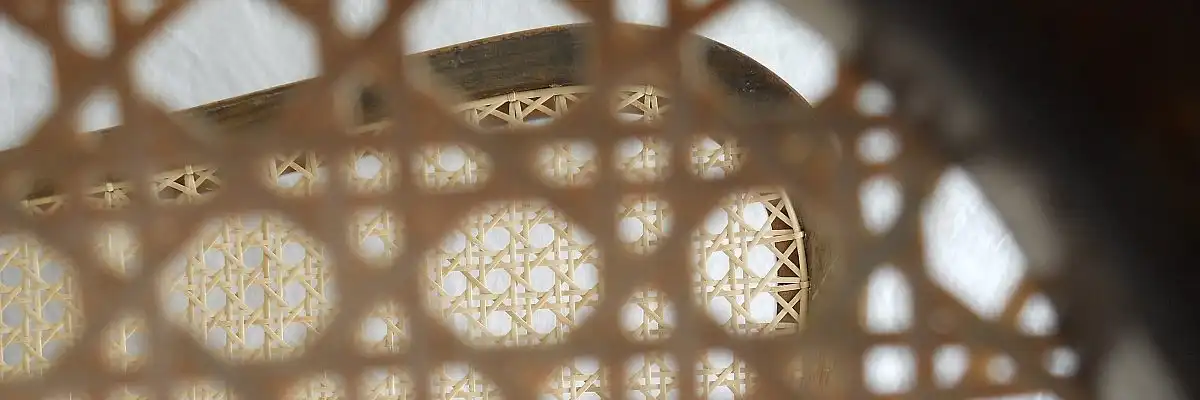
The term chair comes from the Old High German word stuol and means something like seat or throne. Originally used only as a symbol of power because of the elevated sitting position of pharaohs, kings, princes and clergy, from the 16th century onwards the chair was increasingly used by the middle class as seating furniture.
It is proven that chairs with wickerwork were already used by the Egyptians. Not much has changed in the craft work over the centuries. Only modern materials have found their way into basket weaving, which also includes chair weaves.
The furniture that is probably most commonly found today are chairs from the Biedermeier period (approx. 1815 – 1848), the Wilhelminian period (approx. 1850 – 1890) and Art Nouveau (approx. 1900 – 1920).
But even with modern chairs with wickerwork, repairs to maintain their value can often still be worthwhile. A handcrafted seat can represent the connection between past and present and give you a lot of joy when you continue to use your seating.
On this page I would like to show you the individual steps of the most common chair weave (Vienna weave, octagonal weave) so that you can get an idea of the work involved and perhaps even learn to appreciate the craftsmanship behind it.
In most cases, repairing or replacing individual braided threads is not possible. That’s why the entire braid always has to be replaced. After the old braid has been removed and the drill holes have been cleaned of dust, the braiding work can begin.
The structure of a Vienna mesh


All contents of this website, in particular texts, photographs, videos and graphics are protected by copyright. Unless otherwise expressly indicated, the copyright lies with © Korbmacherei Kreative Finger. Other sources used are indicated accordingly.
The reproduction, editing, distribution and any kind of utilisation of the content on this online presence require written consent.